Two paths out of every machine
A pump, a compressor or an engine radiates airborne sound from its casing and its fan, and at the same time pushes vibration through its feet and its pipework into the slab and the walls, which then radiate it somewhere else — typically the neighbour’s bedroom wall. Mass loaded vinyl addresses the first path and does nothing for the second. In a Thai townhouse the second path is usually the whole problem: the pump is bolted to the yard slab against the party wall, and the supply pipe is clamped rigidly to that wall.
| Symptom | Path | Remedy |
|---|---|---|
| A hum felt in the wall or floor; audible where the machine cannot be seen | Structure-borne, through feet and pipes | Rubber mounts, flexible pipe connectors, resilient clamps. MLV will not help |
| Motor or compressor noise, louder closer to the unit | Airborne from the casing | Enclosure or screen lined with MLV and absorber |
| Fan rush from a condenser | Airborne, directional with the airflow | A screen between unit and neighbour; never a box over the unit |
| Generator exhaust note | Out of the tailpipe | A proper exhaust silencer; MLV is for the room, not the pipe |
| Thin steel panels ringing when tapped | The panel itself radiating | BlastVib BB460 damping before any mass |
The rule that decides every enclosure
An enclosure with about 1% open area caps at roughly 20 dB no matter how heavy its walls. But a pump motor needs air, a condenser has to reject heat and a generator has to breathe and cool. The job is therefore not to seal the machine but to make the air go in and out through openings that are lined and turned, so that sound has to pass through absorber before it leaves.
A wall that works has three layers from the inside out: 25 to 50 mm of glass or mineral wool facing the machine to absorb, BlastBlock BB830 at nominally 5 kg/m² as the barrier, and the panel that carries it — 12 mm plywood, fibre-cement board or sheet steel. The material alone is STC 32 according to the manufacturer’s datasheet, reference BB830/20/v2, a laboratory value; the enclosure’s result is set by its openings far more than by the sheet.
The same three layers, bonded at the factory
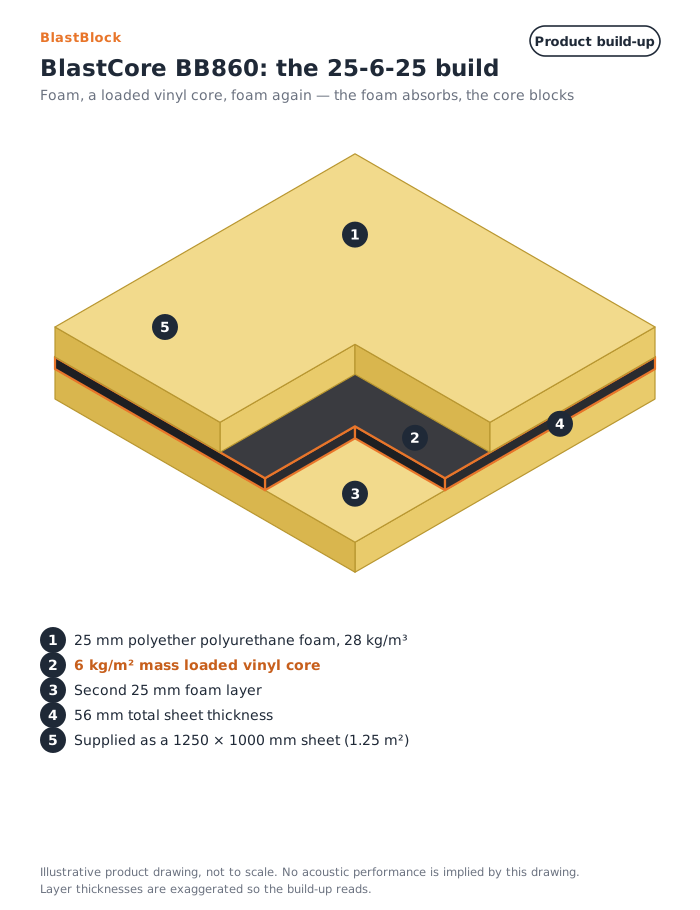
Those three layers are now also stocked as one sheet. BlastCore BB860 25-6-25 is 25 mm of polyether polyurethane foam at 28 kg/m³, a 6 kg/m² mass loaded vinyl core and a second 25 mm foam layer, bonded together: 56 mm in total, supplied as a 1250 × 1000 mm sheet of 1.25 m² and sold in whole sheets only, at THB 3,681 per m² including VAT, which is THB 4,601 a sheet. The first holding is 20 sheets in Bangkok.
The case for it is construction, not performance. The absorbent face arrives already on the side that has to face the machine, so an enclosure panel is one fixing operation instead of three, and the foam on the outer face decouples the vinyl core from the board or steel that carries it. What we cannot tell you is how much quieter it is. No laboratory absorption or transmission figure is published for BB860 — the manufacturer’s datasheet carries construction and materials only — and we will publish one when a report exists. The STC 32 above belongs to BB830 and does not carry over to the composite. We are not claiming BB860 absorbs better, blocks better or performs better than a well-built wool-and-BB830 lining, and it does not touch the rule above: the openings still decide the enclosure, and like any sheet or composite it does nothing at all for the vibration travelling out through the feet and the pipes.
What it costs is depth and money. BB860 needs its 56 mm, where 25 mm of wool over 3 mm of BB830 is about 28 mm — half as thick — so where clearance around the machine is tight, or the box is already built, the hand-built lining is both the thinner and the right answer. It is also the cheaper one per square metre: BB830 is THB 1,122 per m² including VAT with the wool bought separately, against THB 3,681 per m² for the composite, about three times the sheet cost. What comes back is fitting time and a simpler build, not decibels. And because both outer faces are bare foam, an outdoor condenser screen gains nothing from it: the foam still needs a protective facing against sun and rain exactly as wool does, which is why the composite belongs inside an enclosure or a plant room.
A pump enclosure you can build yourself
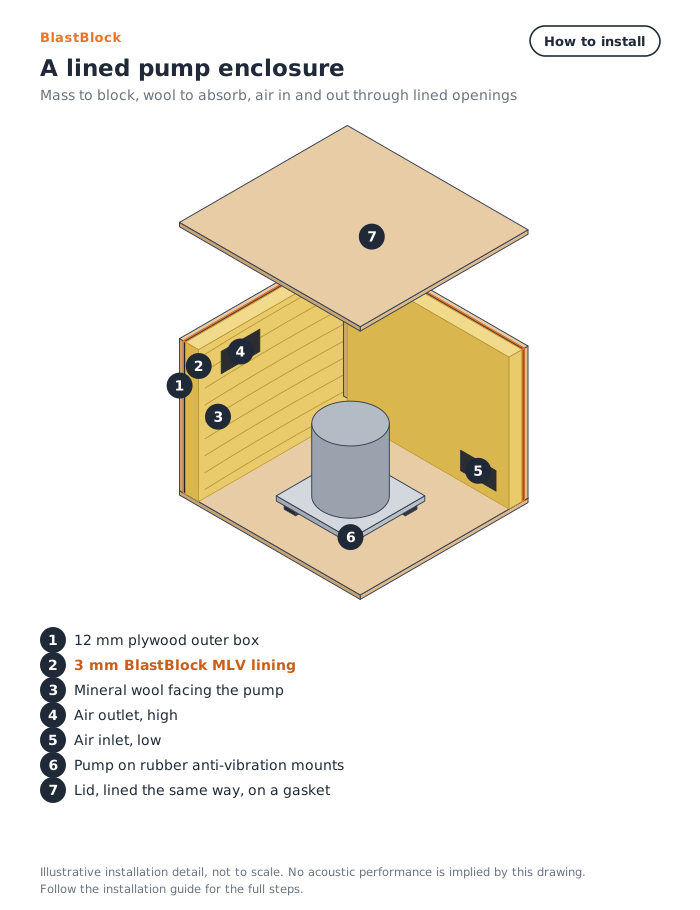
- Set the pump on rubber anti-vibration mounts and fit flexible connectors to the inlet and outlet. Listen before going further.
- Build a box from 12 mm plywood or fibre-cement with at least 100 mm clearance to the pump on every side. Nothing may touch the pump.
- Bond BB830 to the inside of every panel including the lid with BA990, overlap at the corners, and seal every corner with BA890.
- Face the MLV with 25 to 50 mm wool, held with mesh or fabric so fibres do not shed.
- Cut an air inlet low on one side and an outlet high on the opposite side, each turned through a lined 90-degree baffle so there is no straight line from the pump to the outside.
- Make the lid removable on a gasket. The lid joint is the largest opening in the box; it needs a seal, not a gap.
Condensers: screen, never box
An outdoor condenser rejects heat through its fan. Boxing it in raises the discharge temperature, the compressor works harder, consumption rises and the unit fails early. The right form is a screen between the unit and the receiver: a steel or timber frame carrying fibre-cement or sheet metal, BB830 bonded on the machine side, and a perforated or wool-faced absorber over it so the sound does not simply reflect back into your own property.
Make the screen at least 300 mm taller than the unit and extend it past both ends, with returns at the ends. Seal the base to the ground and keep the clearance from the fan discharge that the equipment manual specifies, normally not less than 500 mm. If the neighbour can still see the condenser from their window, the screen is not tall enough.
Generators: line the room, silence the exhaust
A generator has three sources that need three different treatments. The exhaust needs a silencer sized for the engine — MLV has nothing to do with that pipe. The cooling air needs attenuators on the intake and discharge that pass the airflow the radiator requires. The engine’s casing noise is what the plant room walls, ceiling and door control, and that is where MLV belongs: bonded to the inside of the walls and ceiling, with the door changed for a solid leaf sealed on all four sides and every penetration sealed.
Engine noise is low-frequency, so consider BB830LF for the room lining — bearing in mind that its published table stops at 100 Hz while a generator’s dominant tone is often lower still, so send us the spectrum rather than reading the sheet below where it ends. Where the room carries a fire requirement or holds a fuel tank, BB830FR is the grade with an independent fire classification, and BB860 is not a candidate in either case: no laboratory fire result is published for it. Where a plant room carries no fire requirement and holds no fuel, lining the same 54 m² of walls and ceiling with the composite is 44 sheets, which is project scale — ask for a quotation. Keep the sheet clear of the exhaust and of any surface above 93 °C, the manufacturer’s stated heat tolerance.
Quantities and budgets
| Job | Lined area | MLV and accessories | Acoustic materials |
|---|---|---|---|
| Pump box, 1.0 × 0.6 × 0.6 m internal | about 3 m² | 1 roll BB830 + 2 BA990 + 1 BA890 | about 7,200 |
| The same pump box lined with BB860 instead | about 3 m² | 3 sheets BB860 (3.75 m²) + 2 BA990 + 1 BA890 | about 15,300 |
| Condenser screen, 3 × 1.5 m with two returns | about 6 m² | 2 rolls BB830 + 2 BA990 + 2 BA890 | about 13,200 |
| Generator room, 3 × 4 × 3 m, walls and ceiling | about 54 m² | 13 rolls BB830LF or FR | Ask for a quotation — above the online ceiling |
The pump box and the condenser screen sit under the free-delivery threshold, so delivery is THB 500 in Bangkok and the surrounding provinces or THB 900 upcountry; collection from the warehouse is free. A generator room is project work: send the room dimensions and the set’s data sheet for an assessment before ordering.
The BB860 line in that table is the same box, not a better one, and it is sheets rather than a roll: 1.25 m² each, whole sheets only, so 3 m² of lining is three sheets and 3.75 m² of material. Keeping the pump’s 100 mm of clearance around 56 mm of lining means building the carcass 56 mm larger on every face, about 112 mm on each dimension, which lifts the lined area to roughly 4.2 m² and the order to four sheets, about THB 19,900 with the adhesive and sealant. One sheet at THB 4,601 is under the THB 5,000 minimum online order, so two sheets is the smallest order the shop will take.
What MLV will not fix
- Vibration through feet and pipes. Mounts and flexible connectors, not sheet.
- Noise leaving through an open vent. Line and turn the opening, or fit an attenuator.
- A generator exhaust. That is a silencer.
- A condenser that is loud because its fan blade is damaged or its bearing is worn. Service it first; it is cheaper than any screen.
- Very low frequency from large plant, below roughly 125 Hz. Mass alone is weak there; cavity depth and structural separation are needed.